The AI Competitive Gap: Why Your Competitors are Winning (With Copy-and-Paste Strategy Prompts)
Let’s have an uncomfortable, straight-talking conversation about your competitors.
While you are sitting in your office trying to keep up with the daily operational chaos—reviewing standard contracts, responding to minor team emails, and wondering why your printer refuses to connect to the network—a quiet shift is happening down the road.
Your biggest competitor just won a bid that should have been yours.
They didn't do it because they have a better team. They didn't do it because they are working 90-hour weeks. They did it because they stopped waiting for the "future of technology" to arrive and decided to build it themselves.
In business, we often play a dangerous waiting game. We tell ourselves: “I’m going to wait until AI matures before I invest in it. Let the big companies make the expensive mistakes first, then I’ll buy the cheap, perfected version.”
That sounds like smart, conservative business planning. But in the age of rapid automation, it is a recipe for irrelevance.
The competitive advantage of AI isn't about buying a magic software button that runs your entire business. It is about speed, visibility, and decision-making capacity. And right now, the gap between the businesses utilizing secure automation and the ones stuck in "wait and see" mode is widening into a canyon.
Meet Marcus: The Automated Pitmaster
To see how this gap plays out in real life, let’s look at a hypothetical local business owner named Marcus.
Marcus runs a commercial contracting and estimation firm. He has the same number of employees you do. He pays the same local taxes. He buys from the same suppliers.
But Marcus has a secret weapon: He partnered with a managed IT strategist to build a secure, visionary infrastructure.
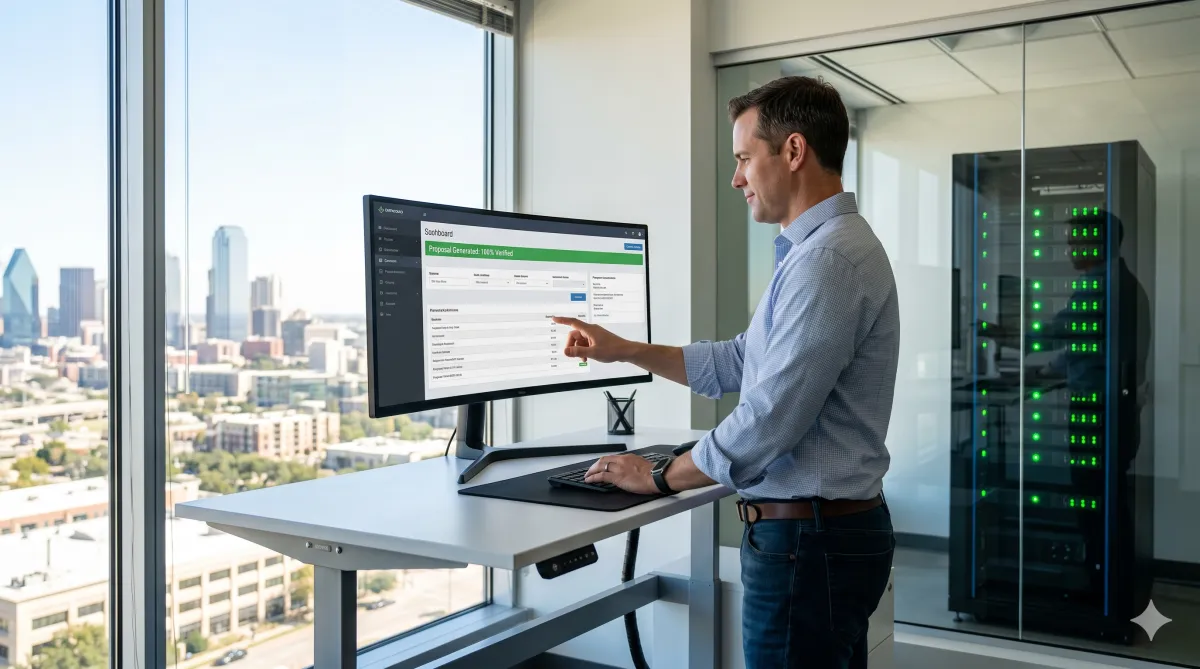
When a high-value bid request comes in, Marcus doesn't spend three days manually copying specs into a spreadsheet. A secure, internal AI pipeline automatically reads the blueprint, estimates the materials based on past local supplier data, checks his team’s current capacity, and drafts a highly customized, competitive proposal within twenty minutes.

Marcus reviews the draft, adjusts a few numbers, and hits send before his competitors have even finished scheduling their initial planning meeting.
Marcus isn't working harder. In fact, he’s taking his family to the lake this weekend. He’s winning because his business has a massive operational speed advantage.
While you are acting as the human switchboard router for your company's data, Marcus has built a system that carries the load for him.
The Cost of the "Wait and See" Strategy
If you think you are "playing it safe" by ignoring AI, let’s look at the actual data.
The Microsoft/LinkedIn 2024 Work Trend Index revealed that 75% of global knowledge workers are already using AI at work.
But here is the kicker: 60% of business leaders worry their organization lacks a plan or a vision for AI implementation.
This means the gap isn’t between "companies using AI" and "companies not using AI." Your team is already using it behind your back.
The real gap is between:
Unregulated Chaos: Unmanaged, insecure free tools that leak your trade secrets and customer data into public servers.
Visionary Infrastructure: A clean, managed, secure system that integrates your tools, protects your data, and streamlines your workflows.

When you transition to a structured, managed tech model, the financial payoff is highly documented. The Brocent Managed Service Financial Study shows that businesses that align their processes with professional tech leadership experience:
A 23% increase in employee productivity from optimized, integrated systems.
A 42% overall reduction in technology spending by cutting out wasted software licenses and duplicate subscriptions.
A 20% to 30% return on investment in the very first year.
Every month you spend waiting is a month you are paying a heavy "inefficiency tax" that your competitors are reinvesting into their growth.
The Barbecue Test: The Stubborn Pitmaster

Think of it this way.
Imagine two local barbecue joints competing in the same town.
The first pitmaster is a traditionalist. He refuses to use any modern technology. He sits on a physical bucket in the heat for 14 hours, manually throwing logs on the fire every twenty minutes, staring at an old analog thermometer. He is exhausted, his cook is inconsistent, and he can only produce ten briskets a day before he burns out.
The second pitmaster uses a custom, insulated offset smoker equipped with a secure, digital temperature controller. He sets his target heat, and the system automatically adjusts the airflow to keep the fire rock-solid. He sleeps through the night, his bark is perfect every single time, and he easily produces fifty briskets a day while spending his afternoon chatting with his customers.
The second pitmaster didn't change the wood, the rub, or the quality of the beef. He simply built an infrastructure that managed the routine maintenance of the fire so he could focus on the experience.
Banning or ignoring AI is like sitting on that bucket in the North Texas heat, refusing to use a thermostat because "the old way worked." It’s not noble; it’s just exhausting.
How to Turn Your CRM into a Competitive Weapon

You don’t need an enterprise-sized budget or a team of developers to start building a competitive advantage. Most modern CRMs (like HighLevel, HubSpot, or Salesforce) already have built-in AI modules that you can utilize today.
Here are two highly strategic, copy-and-paste prompts you can run inside your CRM's AI tool right now to start reverse-engineering your competitor’s positioning and finding your own operational wins.
Tool 1: The Competitor Battle Card Generator
Use this prompt to instantly analyze a competitor's website copy and build a direct sales roadmap for your team on how to beat them.
📋 M3 Networks Copy-Paste CRM Prompt (Competitor Analyzer):
"Act as an elite, straight-talking corporate strategist. Analyze the following competitor positioning text scraped from their website: [Insert website URL]
Identify their three primary value claims, their target audience, and their hidden weaknesses (e.g., where they use generic corporate jargon like 'cutting-edge' or 'comprehensive' without offering real proof). Draft a simple, punchy 300-word 'Battle Card' for our sales team explaining exactly how to position our local, value-first services against them. Keep the tone direct, neighborly, and entirely free of fluff."
Tool 2: The Operational Friction Finder
Use this prompt to analyze your own team’s daily workload and identify the exact processes that are ripe for automation.
📋 M3 Networks Copy-Paste CRM Prompt (Friction Finder):
"Act as a virtual CIO (vCIO) specializing in small business workflow optimization. Read this description of our team's daily administrative routine:
Identify the two highest-friction bottlenecks where our staff is wasting time on manual data entry or redundant email back-and-forths. Provide a step-by-step automation blueprint on how we can integrate our CRM to handle these tasks automatically. Keep the explanation in plain English that a 5th grader could understand."
Build Your Competitive Moat

Technology is no longer just a support department that fixes broken laptops. It is either your primary engine for growth or the anchor that is holding y'all back.
If you are ready to stop playing catch-up, stop wasting hours on low-value coordination, and build a secure, visionary infrastructure that locks in your competitive edge, we are ready to stand down the road with you.
We don't sell generic tech subscriptions. We build custom, secure operational pipelines that give business owners their thinking back.
Let's make IT easy. Let's sit down, run a secure competitive audit of your workflows, and build a runway that leaves your competitors in the dust.
People Also Ask
1. What is the competitive advantage of AI in small business?
The competitive advantage of AI lies in operational speed and resource optimization. Businesses using secure AI can draft bids, respond to client inquiries, onboard customers, and organize meeting decisions in minutes rather than days, allowing them to scale without significantly increasing administrative overhead.
2. Is it better to wait for AI technology to mature before adopting it?
No. While the technology will continue to evolve, the "learning debt" of waiting is incredibly high. Companies that start building secure, structured AI workflows today are establishing cleaner data pipelines and more efficient employee habits, making it very difficult for late-adopting competitors to catch up.
3. What does a virtual CIO (vCIO) do to help a business stay competitive?
A virtual CIO (vCIO) provides fractional executive technology leadership. They align your IT infrastructure with your business goals, identify wasteful software spending, build 3-to-5-year technology roadmaps, and ensure your team has secure, high-ROI automation tools that drive growth.
4. How can I use my existing CRM's AI features safely?
To use CRM AI safely, ensure your platform offers enterprise-grade data privacy and that you are utilizing private API integrations. Avoid pasting sensitive customer personally identifiable information (PII) or trade secrets into free, consumer-grade external AI platforms that do not guarantee data encryption or isolation.
5. How much can a business save by consolidating unmanaged technology?
Studies show that businesses transitioning to a managed IT and technology framework can see up to a 42% reduction in overall technology spending. This is achieved by auditing tech stacks, canceling duplicate licenses, and replacing disconnected third-party subscriptions with structured, integrated workflows.