
AI for CEOs: How to Automate Your Way to Freedom
Let’s talk about that badge of honor you’ve been wearing.
You know the one. It’s the 70-hour workweek.
You tell your friends, your spouse, and maybe even your mirror that you have to work these hours. You say it’s because the business is growing fast. You say it's because "nobody else can handle the high-level stuff."
But let’s tell the radical truth here: You aren't spent-out from leading. You’re drowning in administrative noise.
According to an eye-opening analysis on executive time tracking by CEO coach Eric Partaker on LinkedIn, the vast majority of business owners working those grueling 70-hour weeks are actually spinning their wheels on low-value operational tasks.
You are spend up to 30% of your day playing a high-stress game of digital catch-up.
We call this digital debt. It’s the constant flood of emails, chat pings, and minor employee questions that keep you from doing the one job you actually started this company to do: being the visionary.
If you want to scale your business without losing your mind, you have to stop being the human router. And the fastest way to do that is to build a secure, automated infrastructure.
Are You the Human Router?

Close your eyes and picture a vintage telephone switchboard from the 1950s.
Now, picture yourself standing in the middle of your office with cords plugged into your ears, manually connecting every single person in your company to the information they need.
“Where is the plumbing bid for the North project?” Plug.
“How do we format this client onboarding email?” Plug.
“Did we get approval on that invoice?” Plug.
This is how most small business owners run their offices. You are the sole repository of company knowledge. Because you hold all the answers, your team has to constantly interrupt you to do their jobs.
This doesn't just slow them down. It kills your ability to think.
To break this cycle, you need to move from a "people-dependent" system to a "process-dependent" system. You don't need another middle manager. You need a secure AI system designed to hold your company's operational context.
The Reality of Winning Back 20 Hours a Week

When people talk about "AI for CEO productivity," they usually suggest downloading a generic chatbot and asking it to write some social media posts.
That is not what we are talking about. Writing a mediocre post about "motivation" is not going to save your business or your sanity.
What will change your life is systemic automation.
A recent study on executive workload reduction by Marblism's CEO Time Optimization Report revealed that business owners who implement structured, private AI workflows save an average of 20 hours per week.
Think about that for a second. That is half a workweek.
What would you do with an extra 20 hours?
Would you finally hunt down that major acquisition target?
Would you spend a quiet morning working on your 3-year strategic plan?
Or would you just go home at 3:00 PM on a Friday and actually watch your kid's baseball game without checking your phone under the bleachers?
This is not a pipe dream. It’s what happens when you let technology handle the shallow tasks so you can focus on the deep ones.
The Three Steps to Chief Executive Liberation
You don’t have to automate your entire business overnight. That’s how systems break and people get confused.
Instead, start by automating the three biggest drains on your daily cognitive capacity:
1. Meeting Triage and Decision Retention
You spend half your week in meetings. You take notes, you assign tasks, and then you spend the next three days emailing people to make sure they actually do what they agreed to do.
With secure, internal AI integrations, your meetings can be recorded, transcribed, and structured into direct action items automatically. The system doesn't just write a summary; it assigns the tasks in your project management software and drafts the follow-up emails for you to approve with one click.
2. The Internal "Knowledge Base" Filter

Stop answering the same ten operational questions every day.
By building a private, secure AI model trained only on your internal company wiki, standard operating procedures (SOPs), and past bids, your team can ask the system their questions directly.
Instead of asking you, "What is our policy on mobilization fees for out-of-town jobs?" they ask your private business assistant. The system pulls the exact answer from your archive instantly, keeping you completely out of the loop.
3. Communication Overload Cleanup

Your inbox is currently a digital crime scene.
By utilizing advanced, secure email filtering, you can train a private assistant to categorize your incoming mail not just by "sender," but by "intent."
It can draft responses to routine client inquiries, highlight the critical issues that actually require your personal eyes, and archive the noise before it ever distracts you.
Banish the Chaos, Build the Infrastructure
I know what you might be thinking: "This sounds great, but I’m not a tech person. I don't have the time to sit down and program an AI to clean up my email."
You shouldn’t have to. You’re the CEO, not the developer.
Your job is to define the goals of the business. Our job is to build the technology that gets you there.
When we talk about building a Visionary Infrastructure, we mean setting up a secure, managed foundation where your technology works for you—not the other way around.
We don't just hand you a login to some third-party tool and wish you luck. We sit down with you, find the high-friction bottlenecks that are keeping you at your desk at 7:30 PM, and build custom, secure automation workflows to eliminate them.
Actionable Micro-Tip: The "Time-Drain" Audit
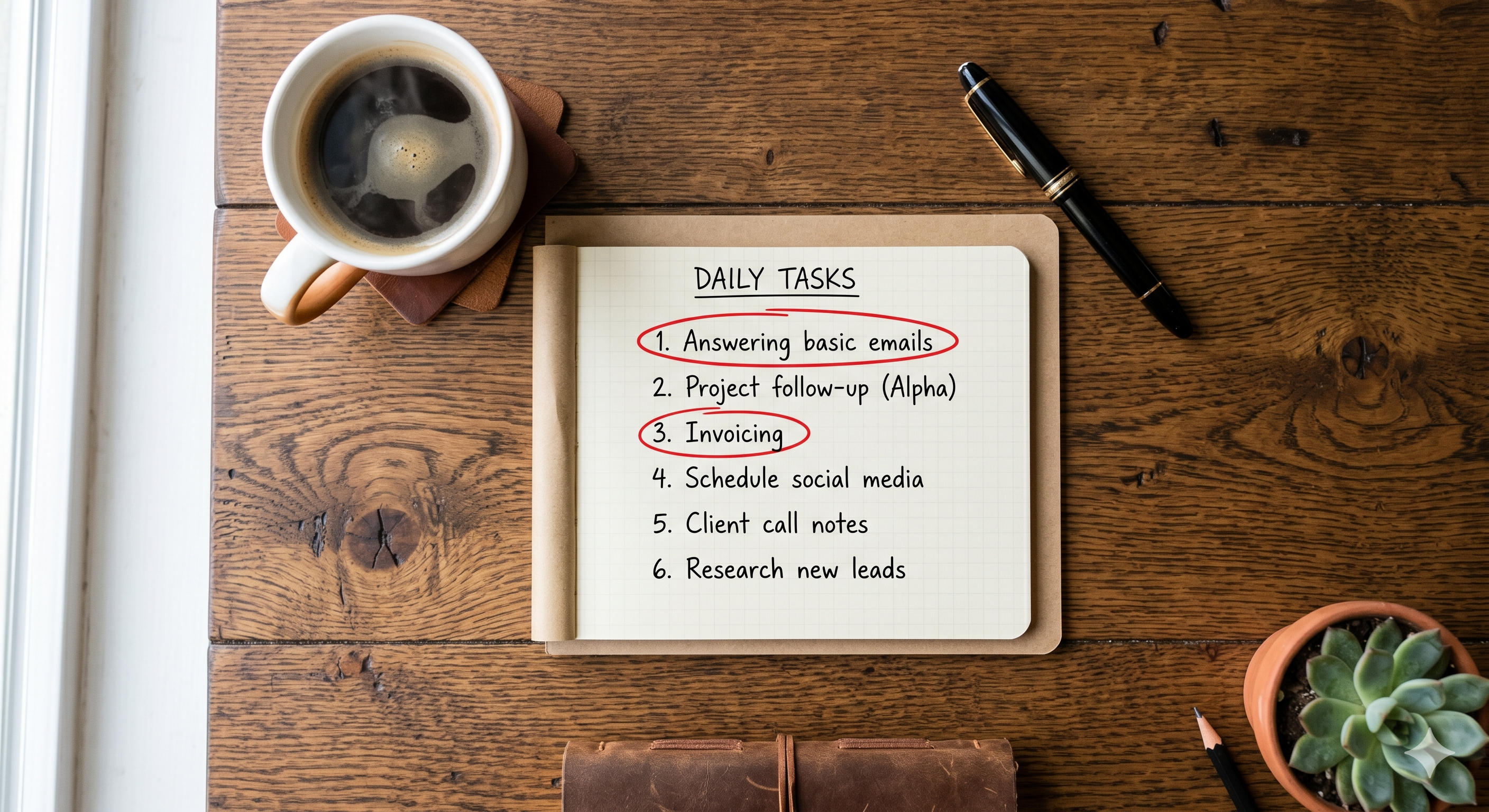
Before you spend a single dollar on software, you need to know where your time is actually leaking.
For the next three days, keep a simple notepad next to your keyboard. Every time you switch tasks, write down what you are doing and how long it took.
At the end of the third day, highlight every task that didn't require your unique creative vision or signature authority.
If it’s data entry, scheduling, status updates, or email follow-ups, circle it in red. That red circle is your roadmap to winning back your first 5 hours next week.
Get Your Thinking Back
The "tyranny of the immediate" is a choice. You can choose to keep standing at the switchboard, plugging in cables until you burn out. Or you can choose to build an infrastructure that runs itself.
Let's make IT easy. Let's get your focus back where it belongs—on growing your business and enjoying your life. Book a 20-minute AI consult with us today!
People Also Ask
1. How can AI improve CEO productivity?
AI improves executive productivity by offloading repetitive administrative tasks. This includes summarizing meetings, drafting emails, organizing project management tasks, and triaging inboxes. By automating these low-value tasks, CEOs can focus on high-level growth strategy.
2. Is it safe to train an AI on my company's internal data?
It is only safe if you use a secure, private, enterprise-grade AI instance. Public tools (like the free version of ChatGPT) use your data for training, which exposes your trade secrets. Managed AI solutions keep your data fully encrypted and completely siloed within your business environment.
3. What is digital debt and how does it affect business owners?
Digital debt is the operational exhaustion caused by managing too many emails, chats, meetings, and notifications. For business owners, this constant noise prevents deep strategic thinking and forces them to work long hours just to handle basic communication.
4. How many hours can a business realistically save by using automation?
Case studies show that small to medium-sized business owners can save an average of 10 to 20 hours per week by implementing custom, automated workflows to handle routine scheduling, invoicing, and knowledge-sharing.
5. How do I start implementing AI in my business without tech expertise?
The safest way to start is through an AI readiness assessment or consultation. A managed services provider can analyze your existing workflows, identify the bottlenecks, and implement secure, ready-to-use automations so you don't have to write any code.